Chapter thirteen
Explore: Counterfeit Gods
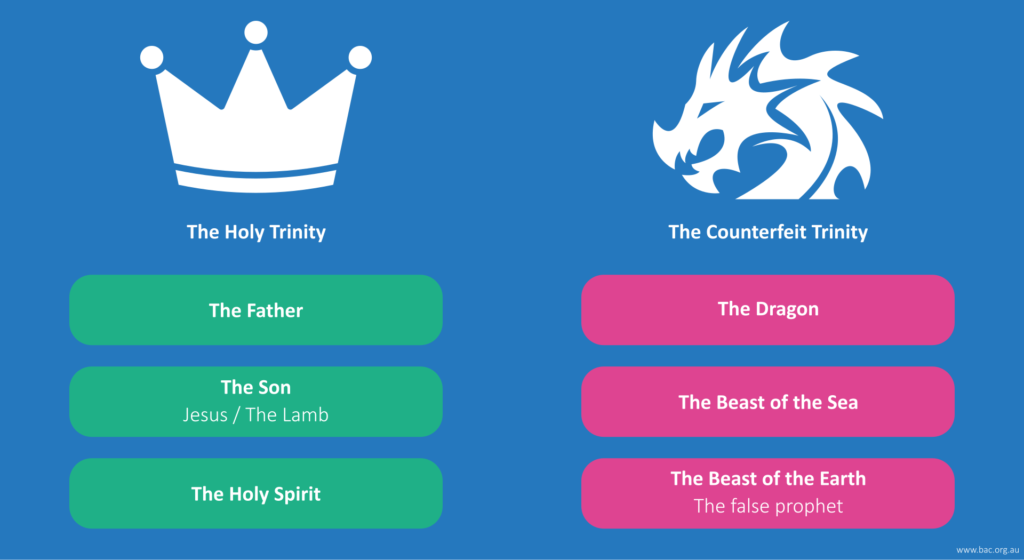
Revelation chapters 12-20 speak at length about the dragon, the beast and the false prophet (initially called the second beast). They form an unholy trinity.
In Revelation 12, the dragon appears and seeks to take the place of God, but is overwhelmingly defeated.
Revelation 13 describes a beast out of the sea and a beast out of the earth. The descriptions of these creatures and their actions show that they are images of the dragon, and continue his work in different ways. They act as counterfeit versions of the Holy Trinity.
The beast out of the sea appears to be a counterfeit version of the Messiah. He is fatally wounded and then resurrected (13:3, 14). He bears blasphemous names, in contrasts with Jesus’ worthy name (13:2, 19:16). In Revelation 19, Jesus comes face to face with the beast for a final confrontation. But there is no battle. The beast is defeated in the blink of an eye.
The beast out of the earth appears to be a counterfeit version of the Holy Spirit. He is later called the False Prophet (16:13, 19:20). He performs great signs (13:13), has the power to give life (13:15), and compels people to worship an image of the first beast.
The Beast out of the Sea
13 The dragon stood on the . And I saw a beast coming out of the sea. It had , and on each head a blasphemous name. 2 The beast I saw resembled a leopard, but had feet like those of a bear and a mouth like that of a lion. The dragon gave the beast his power and his throne and great authority. 3 One of the heads of the beast seemed to have had a fatal wound, but the fatal wound had been healed. The whole world was filled with wonder and followed the beast. 4 People worshiped the dragon because he had given authority to the beast, and they also worshiped the beast and asked, “Who is like the beast? Who can wage war against it?”
5 The beast was given a mouth to utter proud words and blasphemies and to exercise its authority for forty-two months. 6 It opened its mouth to blaspheme God, and to slander his name and his dwelling place and those who live in heaven. 7 It was given power to wage war against God’s holy people and to conquer them. And it was given authority over every tribe, people, language and nation. 8 All inhabitants of the earth will worship the beast—all whose names have not been written in the Lamb’s book of life, the Lamb who was slain from the creation of the world.
9 Whoever has ears, let them hear.
10 “If anyone is to go into captivity,
into captivity they will go.
If anyone is to be killed with the sword,
with the sword they will be killed.”
This calls for patient endurance and faithfulness on the part of God’s people.
11 Then I saw a second beast, coming out of the earth. It had two horns like a lamb, but it spoke like a dragon. 12 It exercised all the authority of the first beast on its behalf, and made the earth and its inhabitants worship the first beast, whose fatal wound had been healed. 13 And it performed great signs, even causing fire to come down from heaven to the earth in full view of the people. 14 Because of the signs it was given power to perform on behalf of the first beast, it deceived the inhabitants of the earth. It ordered them to set up an image in honor of the beast who was wounded by the sword and yet lived. 15 The second beast was given power to give breath to the image of the first beast, so that the image could speak and cause all who refused to worship the image to be killed. 16 It also forced all people, great and small, rich and poor, free and slave, to receive a mark on their right hands or on their foreheads, 17 so that they could not buy or sell unless they had the mark, which is the name of the beast or the number of its name.
Explore: A Mark on their Foreheads
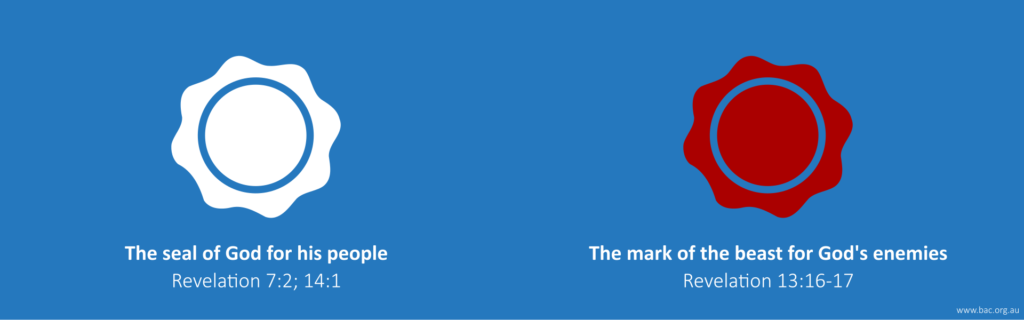
The mark is a direct contrast to the mark and seal on God’s people in Revelation 7:2 and 14:1. Just as God’s people will be clearly marked and set apart, those who oppose God and his people will be marked accordingly.
Attempts to identify the mark as something visible or specific (such as a barcode or modern day computer chip) miss the main point of simple contrast.
The mark also serves to highlight that there is no neutral territory. You either have one mark or the other; you are God’s people or you are God’s enemy. The contrast will again be made in Revelation 14:1, where God’s people have the Father’s name written on their foreheads.
18 This calls for wisdom. Let the person who has insight calculate the number of the beast, for it is the number of a man. That number is 666.
Explore: 666

Much has been written about this number, and many attempts have been made to decipher the supposed puzzle it contains into the name of a particular individual in history.
It is possible that John had a particular individual in mind in this reference, one who would have been easily recognised by John’s original readers. But modern readers have no need to seek to identify who this may have been (and many theories have been put forward!), as the point here is not in their specific identity, but in what they represent.
At a basic level, we can say that the number 777 would symbolise God’s completeness and perfection, and therefore the number 666 is symbolic of falling short of that. Thus, it is entirely appropriate that this appears at the end of two chapters that speak about a counterfeit trinity – three counterfeit gods. Though they bear some similarity to the Holy Trinity of God, they fall well short of that, and are merely deceptive counterparts.
John’s encouragement at the beginning of verse 18 that “This calls for wisdom” points us in a helpful direction for understanding the number 666.
As with Revelation as a whole, this number is not a code that we need to decipher in order to understand John’s message. Rather, the number is symbolic of all that is evil and stands against God, his purposes and his people. The call for wisdom is a call to be people who are discerning, who can identify false gods and false idols for what they are.
As Vern Poythress elegantly wrote:
“Revelation calls not for cleverness but for spiritual discernment.”[1]
[1] Vern S Poythress, The Returning King (New Jersey: P&R, 2000), 148.
Scripture quotations taken from The Holy Bible, New International Version® NIV®
Copyright © 1973, 1978, 1984, 2011 by Biblica, Inc.
Used with permission. All rights reserved worldwide.